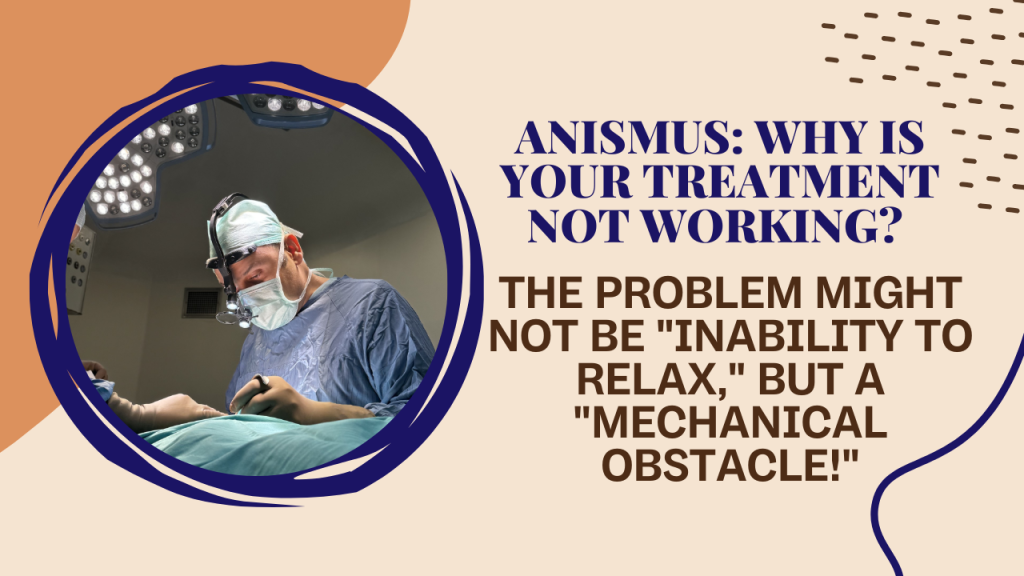
In our previous article, we defined Anismus as a condition where the anal muscles fail to relax properly during defecation. In other words, the muscles do not coordinate correctly, making bowel movements difficult.
However, many patients visiting our clinic ask the same question:
“Doctor, I have been undergoing Biofeedback therapy and following a strict diet for months, yet my difficulty in defecation hasn’t improved. Why?”
If you are receiving treatment for Anismus but still experience symptoms, your diagnosis may be incomplete or inaccurate.
In many cases, the real issue is not muscle dysfunction, but rather a physical mechanical obstruction inside the anal canal or rectum that has been overlooked.
In this article, we will explore several hidden conditions that mimic Anismus symptoms, yet require completely different treatment approaches.
Conditions Commonly Mistaken for Anismus
Not every patient experiencing difficulty in defecation actually has Anismus. Several structural conditions can produce very similar symptoms but involve physical blockages rather than muscle coordination problems.
Below are the most common conditions that are frequently misdiagnosed as Anismus.
1. Anal Stenosis (Anal Narrowing)
A significant number of patients initially diagnosed with Anismus are later found to have Anal Stenosis, a condition characterized by narrowing of the anal canal.
Patients are particularly at risk if they previously underwent:
- Hemorrhoid surgery
- Anal fissure surgery
- Laser procedures in the anal region
Key Difference from Anismus
- Anismus: The muscles contract abnormally and fail to relax.
- Anal Stenosis: The tissue has hardened and narrowed, creating a physical restriction.
Typical Symptoms
Patients with anal stenosis often report:
- Severe and prolonged pain during or after bowel movements
- A tearing sensation during defecation
- Bleeding
- Recurrent fissures caused by straining
If these symptoms are present, the problem is much more likely to be anal stenosis than Anismus.
Biofeedback therapy cannot correct this narrowing. In most cases, surgical correction (flap surgery) is required.
2. Occult Rectal Prolapse (Internal Intussusception)
When people hear the term rectal prolapse, they usually imagine the bowel protruding outside the body.
However, in Occult Rectal Prolapse, the bowel folds inward into itself, rather than protruding outward.
How It Causes Defecation Problems
During straining, the upper part of the rectum slides downward and blocks the anal opening like a plug.
Why It Is Often Misdiagnosed as Anismus
The patient feels a blockage and naturally strains harder. If a careful examination is not performed, this mechanical obstruction may be mistaken for muscle dysfunction.
For accurate diagnosis, examination should be performed in two positions:
- Normal resting position
- Straining position (similar to sitting on the toilet)
Typical Symptoms
Common symptoms include:
- Persistent feeling of incomplete evacuation
- Mucus discharge from the anus
- The need to strain excessively
3. Solitary Rectal Ulcer Syndrome (SRUS)
Solitary Rectal Ulcer Syndrome (SRUS) is a condition often associated with internal prolapse.
As the rectum repeatedly collapses inward and presses against the anal canal, a chronic ulcer may develop inside the rectum.
Important Diagnostic Clue
Bleeding is rare in pure Anismus.
If your symptoms include:
- Rectal bleeding
- Mucus discharge
- Persistent straining
then the underlying issue may involve tissue damage rather than muscle dysfunction.
4. Rectocele (Rectal Herniation)
Rectocele is more commonly seen in women.
In this condition, part of the rectum bulges toward the vaginal wall, creating a pocket where stool accumulates.
Because stool becomes trapped in this pocket, normal evacuation becomes difficult.
The Critical Question
Many patients with rectocele need to use manual support to complete bowel movements.
Ask yourself the following question:
Do you need to press on the vagina or the edge of the anus with your finger to complete defecation?
This technique is called digital splinting.
If your answer is yes, your symptoms are far more consistent with rectocele rather than Anismus.
Quick Comparison: Functional vs Mechanical Causes
| Symptom | Pure Anismus (Functional Problem) | Mechanical Obstruction |
| Main problem | Muscle coordination issue | Physical blockage |
| Stool shape | Fragmented, difficult to pass | Thin or pencil-shaped (especially in stenosis) |
| Need for finger assistance | Rare | Common |
| Bleeding or mucus | Usually absent | Frequently present |
| Biofeedback treatment | Effective | Usually ineffective |
| Surgical history | Usually none | Often present |
How to Achieve a Definitive Diagnosis
If your symptoms persist despite treatment, it is important not to settle for a single diagnosis.
Advanced diagnostic methods can help reveal the true underlying cause.
1. Defecography (Defecation X-ray)
Defecography is considered the gold standard test for evaluating defecation disorders.
During this imaging procedure, X-ray images are taken while the patient strains, allowing physicians to detect:
- Internal prolapse
- Rectocele
- Anal narrowing
- Other structural abnormalities
2. Balloon Expulsion Test
This test evaluates how effectively the anal muscles function during defecation.
It helps determine whether the problem is muscular coordination or structural obstruction.
3. Detailed Physical Examination
An experienced proctologist can often identify whether the issue stems from muscle contraction or tissue narrowing through a careful digital rectal examination.
If you are being treated for Anismus but your symptoms persist, the problem may not be muscle dysfunction at all.
A mechanical obstruction such as anal stenosis, occult prolapse, rectocele, or rectal ulcer could be preventing normal bowel movements.
Simply put:
If there is a physical obstacle blocking the road, improving the driver’s skills will not solve the problem.
The obstacle itself must first be identified and removed.
This article was prepared for informational purposes by Assoc. Prof. Dr. Yahya Çelik.